
Menu

Originally published: 2016 | Last updated: 09-25-26 – This Meaning of Pink guide draws on years of researching color, with enhanced explanations and updated examples.
Where do we find the meaning of pink? Do we capture the curve of a blooming rose? Are we drawn to the flush of healthy cheeks on a chilly day? Is the meaning found in the tightly swaddled form of a newborn baby girl? Pink delights us all—men, women, children, and adults alike.
Pink is a disarming color. It softens whatever it touches, taking the edge off red’s intensity while keeping its warmth. Pink can read as delicate or bold depending on how it’s used, and that range is part of what lets it work as both a childhood color and a grown-up statement.
The color of frivolity lives between red and white. Pink takes all the passion and energy of red and tempers it with the purity of white, leaving us with the color of tenderness and affection.
Pink has been definitively linked to toning down aggression, and its use in holding cells for violent criminals has been quite effective. Some sports teams have even painted opposing teams’ locker rooms pink in an attempt to reduce aggression. Pink is such an effective mood regulator that too much of it can be physically draining. Dark pinks have effects similar to red—heightened emotions, while pale pinks are more soothing.
Pink symbolizes youth, good health, and playfulness. It’s the flush of first love and stands for nurturing femininity. It’s used as the symbolic color of the movement to support breast cancer research, and we think of pink as an innocent, cheerful color.


Your own experience of pink is just as real as these universal and cultural layers. Maybe pink calls up a nursery you painted for a new baby, a favorite childhood toy, or the exact shade of a corsage from a first dance. Personal memories like these are why the same shade of pink can feel sentimental to one person and saccharine to another.
We associate pink with the innocence of childhood and unabashed play. If giggles had a color, it would be pink, and pink used in design reveals a willingness to embrace wonder and creativity. Pink can soften formal design, and its influence can lighten up dark, stodgy colors.
Pink can be associated with passivity, and an unwillingness to take matters seriously. We think of pink as the color of inexperience and associate it with weakness and inhibitions. Pink can also be associated with timidity or a tendency to be overly emotional.
Blush and dusty pinks work beautifully as a soft neutral in bedrooms and living spaces, pairing well with warm woods, brass, and cream. Bright or hot pinks make strong, playful accents—a single wall, a piece of furniture, textiles—rather than an entire room, which can start to feel overwhelming.
Soft pinks are broadly flattering and read as warm and approachable, while deeper pinks and magentas make a bolder, more confident statement. Pastel pink pairs easily with neutrals for a polished look; hot pink works best as a single statement piece rather than head-to-toe.
The pink fairy armadillo lives in Argentina and is the smallest of all the armadillos. They weigh less than a pound and forage for ants, worms, and other insects. Pink fairy armadillos live underground and emerge to find food at night.
The little finger is often referred to as the “pinky,” and the origin goes back to an obsolete meaning of “pink” to refer to something small.
Before the famous band we know as Pink Floyd went by that name, they were called The Pink Floyd Sound. They also went by earlier names The Tea Set and Abdabs. Roughly 1 in 12 people own a copy of Pink Floyd’s Dark Side of the Moon album from 1973.
Dubble Bubble bubblegum was invented in 1928, and got its pink color because that was the only color dye its creator, Walter Diemer, had on hand. The record for the largest bubble ever blown with bubblegum is held by Susan Montgomery Williams, who blew a 23-inch bubble in 1994.


Examples of how the meaning of pink colors our language:

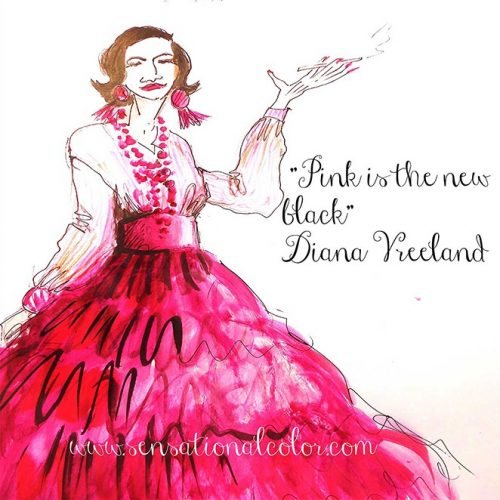


See more quotes about the color pink.


Some people make pink their defining shade. Mamie Eisenhower wore a pink gown covered in 2,000 rhinestones to Ike’s first inauguration, and the exact tone of her wardrobe and decor became known as “First Lady Pink” or “Mamie Pink.” The look caught on nationally: pink bathroom fixtures, tile, and kitchen appliances were everywhere in American homes from about 1954 through 1960. Decades later, singer-songwriter Alecia Beth Moore built an entire stage identity around the color when she became simply Pink—a name with a far less innocent origin story than the color itself suggests.

Pink anchors a surprising range of brand identities, from Victoria’s Secret and Mary Kay to T-Mobile’s trademarked magenta and the pink ribbon of breast cancer awareness. Cosmopolitan, Thomas Pink, Lyft, Baskin Robbins, Vineyard Vines, and Barbie have all built recognizable looks around some shade of pink, while Owens Corning trademarked a specific pink for its insulation and Pepto-Bismol turned the color into shorthand for stomach relief.

Pink Hill, North Carolina takes its name from a hillside where fields of pink flowers bloomed every spring on the farm of original settler Anthony Davis. A handful of other towns share the color’s family: Glen Rose, Texas; Rose City, Michigan; and Rose Hill in both Kansas and Virginia.

Pink turns up throughout popular music, from The Cure’s moody “Mr. Pink Eyes” and dreamy “A Pink Dream” to more upbeat takes like Aerosmith’s “Pink,” John Cougar Mellencamp’s “Pink Houses,” and Bruce Springsteen’s “Pink Cadillac.” OutKast paired it with another hue on “Pink & Blue,” and Henry Mancini’s instrumental “Pink Panther Theme” turned the color into one of the most recognizable melodies in film history. See more songs with color.
Scent and color are more connected than most people realize. Crayola’s pink “Bubblegum” crayon was originally scented to match, until reports of kids nibbling on food-scented crayons pushed the company to switch pink’s scent to “Shampoo.” Researchers have found the connection runs both ways: a PLoS One study on odor-color associations found people reliably matched fruity scents to pink and red, and musty scents to orange and brown. Color shapes taste, too—pastries have been shown to taste better served in pink packaging or on pink plates, and pink’s association with sugar may be exactly why cotton candy (invented in 1897 as “Fairy Floss“) took on the color it did.
Pink symbolizes youth, tenderness, and nurturing affection. It softens red’s intensity with white’s purity, which is why it reads as gentle and approachable rather than passionate.
Certain shades of pink (sometimes called “drunk tank pink”) have been used to calm aggression in institutional settings, though the calming effect fades with prolonged exposure and its real-world reliability is debated.
No—pink was marketed as a boy’s color in parts of the early 20th century before shifting to its modern feminine association, and it’s widely worn across genders today.
A favorite color is just a preference; a signature color is one someone wears or surrounds themselves with so consistently that it becomes associated with them—Mamie Eisenhower’s “Mamie Pink” is a good example.
Consider your own relationship with pink. Does a particular shade feel nostalgic, playful, or a little too sweet? Do you reach for it as a pick-me-up, or avoid it because it feels like it doesn’t take you seriously? Both reactions are common, and both are valid—pink asks more of us emotionally than its cheerful reputation suggests.
What draws you to pink, or pushes you away from it? I’d love to hear about your favorite shade of pink and what it means to you. Share your pink experiences in the comments below—your insights might inspire others, and we may add what you share to this page.


